Vajrasana: The Diamond Posture that Bridges Yoga, Ayurveda, and Daily Life
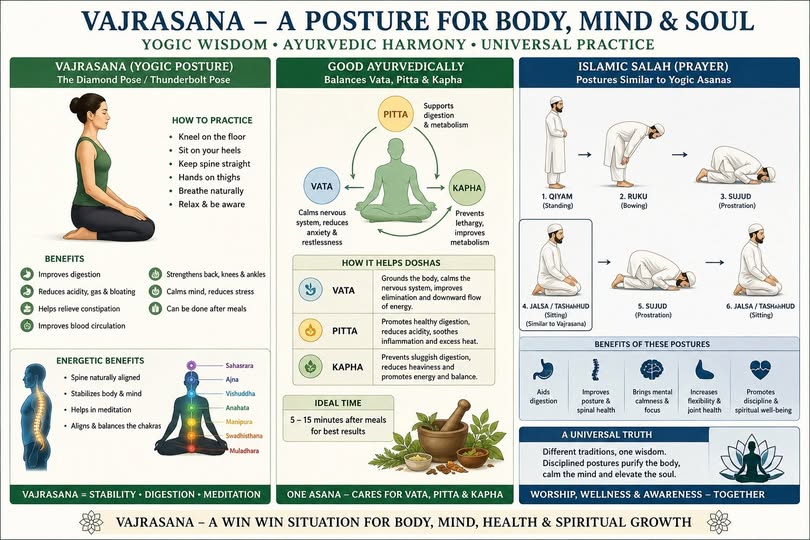
Among the countless yogic postures described in the ancient traditions of India, **Vajrasana (The Diamond Pose or Thunderbolt Pose)** occupies a unique position. Unlike many asanas that are recommended before meals, Vajrasana is one of the very few postures traditionally advised **immediately after eating**, making it both practical and therapeutic.
For thousands of years, yogis have recognized Vajrasana as a posture that promotes physical health, mental stability, and spiritual growth. Interestingly, millions of Muslims around the world also sit in a posture very similar to Vajrasana during the performance of **Salah (Namaz)**. While the primary purpose of Salah is worship and submission to Allah, the physical posture itself also offers several physiological benefits that align with the ancient understanding of yoga.
Why is it called Vajrasana?
The Sanskrit word **”Vajra”** means *diamond* or *thunderbolt*—symbolizing strength, stability, and indestructibility. Regular practice is believed to strengthen both the body and the mind.
Benefits for the Physical Body
Practicing Vajrasana for just **5–15 minutes daily** offers numerous health benefits:
* Improves digestion
* Reduces acidity
* Helps relieve gas and bloating
* Prevents constipation
* Improves blood circulation
* Strengthens the lower back
* Supports knee and ankle flexibility
* Improves posture
* Calms the nervous system
* Reduces stress and anxiety
One of its greatest advantages is that it can be comfortably practiced after meals, making it an ideal posture for modern lifestyles.
Vajrasana and Ayurveda
Ayurveda explains that health depends upon the balance of the **three doshas**:
Vata (movement and air)
Pitta (fire and metabolism)
Kapha (structure and stability)
Many Ayurvedic practitioners recommend Vajrasana because it positively influences all three.
Vata
Vata governs movement, the nervous system, and the digestive tract.
Sitting steadily in Vajrasana helps calm excessive Vata by grounding the body and improving the downward movement of digestive energy.
Pitta
Pitta governs digestion and metabolism.
By improving circulation around the stomach and abdominal organs, Vajrasana assists healthy digestion and reduces excessive acidity without overstimulating the digestive fire.
Kapha
Kapha governs stability, lubrication, and structure.
Regular practice prevents sluggish digestion and encourages healthy metabolism, helping reduce Kapha-related stagnation.
Thus, one simple posture supports the harmonious functioning of **Vata, Pitta, and Kapha**—making it remarkably valuable from an Ayurvedic perspective.
—
Vajrasana and the Subtle System
According to Sahaja Yoga, the human being possesses not only a physical body but also a **subtle energy system** consisting of **chakras**, **nadis (energy channels)**, and the **Kundalini**.
When sitting in Vajrasana:
* the spine naturally becomes erect,
* the body’s centre of gravity stabilizes,
* attention becomes inward,
* and the subtle system is better aligned.
This balanced posture facilitates meditation by reducing unnecessary physical movement and allowing the attention to settle more easily in the present.
Many meditation traditions therefore recommend sitting with an upright spine and a stable base—qualities naturally provided by Vajrasana.
—
Vajrasana During Salah
Muslims across the world perform several cycles of standing, bowing, prostrating, and sitting during Salah.
The seated position between prostrations and at the conclusion of the prayer closely resembles Vajrasana or a related kneeling posture.
While the primary purpose of Salah is spiritual devotion and remembrance of Allah, it is noteworthy that this posture also promotes:
* healthy digestion,
* spinal alignment,
* flexibility,
* mental calmness,
* and physical discipline.
Whether this physiological benefit was consciously recognized historically or simply accompanied a devotional practice, it illustrates how religious traditions can incorporate movements that support well-being.
—
# The Meeting Point of Three Ancient Sciences
Vajrasana beautifully illustrates how different streams of wisdom converge.
**Yoga** recommends it for meditation and physical balance.
**Ayurveda** values it for supporting the balance of Vata, Pitta, and Kapha.
**Daily devotional practice**, such as the seated portion of Salah, includes a similar posture that millions perform regularly around the world.
A Simple Habit with Lasting Benefits – Vajrasana
In today’s fast-paced world, people often search for complicated health solutions.
Yet one of the simplest practices requires nothing more than a few minutes of sitting quietly.
Practice Vajrasana for **5 to 15 minutes after meals**.
Breathe naturally.
Keep the spine straight.
Allow the mind to become still.
Over time, this humble posture can contribute to better digestion, improved posture, greater mental calmness, and a more balanced lifestyle.
Perhaps that is why the ancient yogis preserved it for thousands of years.
Sometimes, the simplest practices are the most profound.
Vajrasana truly is a win-win posture—for the body, the mind, and, for many practitioners, the journey toward inner balance.